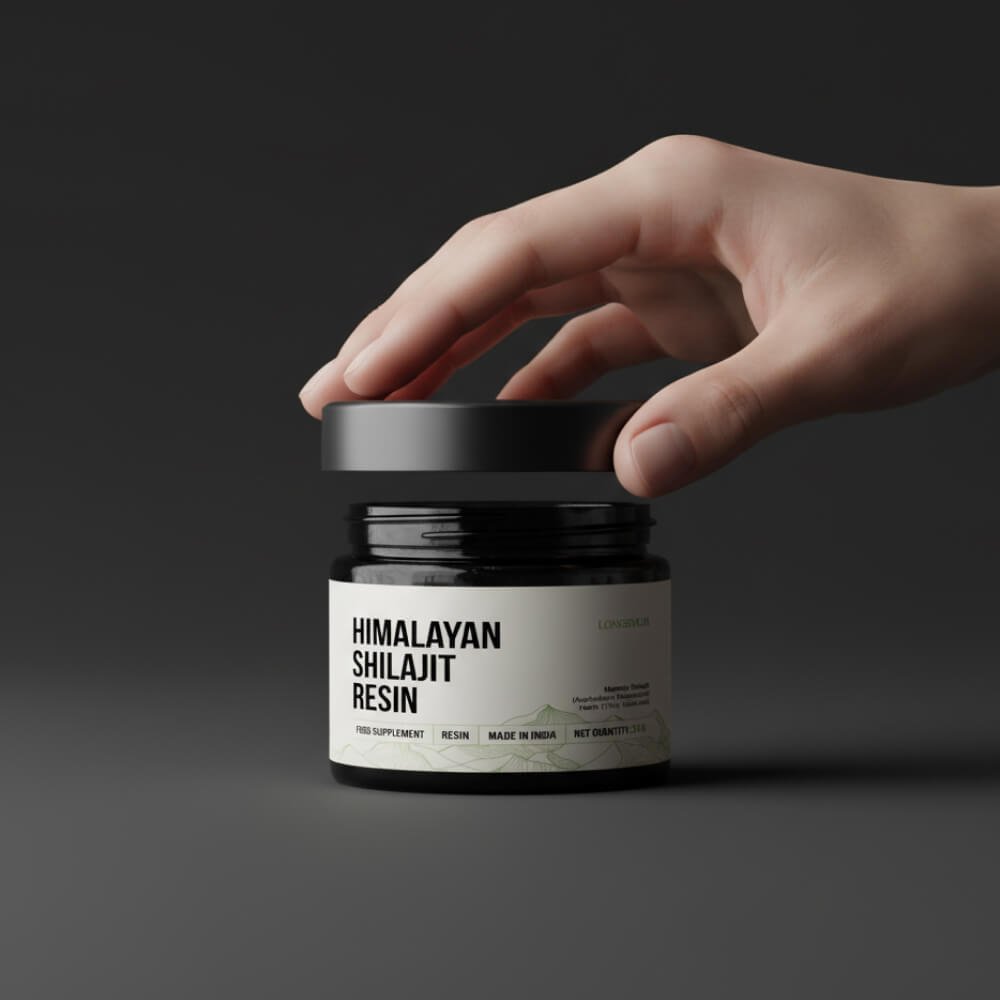
Shilajit resin is straightforward to use, but the unfamiliar appearance and strong taste can be off-putting for first-time users without guidance. This page covers everything you need to know to use shilajit resin confidently and consistently — from measuring your dose to choosing the best preparation method and building a habit that works.
For full product details, visit our Himalayan Shilajit Resin page. For testing and quality documentation, see our research and testing page.
Step 1: Measure Your Dose
Shilajit resin is dense and potent. A typical starting dose is 300 mg — approximately the size of a dry pea, or a small rice grain. Most jars include a small measuring scoop. If yours does not, a standard toothpick tip or the corner of a small spoon can help gauge the amount.
The resin’s consistency changes with temperature. In a warm room, it will be soft and pliable — you can roll a portion between your fingers to shape it. In a cold environment, it may be harder and require slightly more effort to portion. If the resin has become very hard, place the sealed jar in warm (not boiling) water for a few minutes to soften it before measuring.
For a comprehensive review of dosing research, see our shilajit dosage page.
Step 2: Dissolve in Warm Liquid
The most common and practical preparation method is dissolving your measured portion in warm liquid. The liquid should be warm but not boiling — very high temperatures may degrade some bioactive compounds, particularly the thermally sensitive dibenzo-α-pyrones. Aim for a temperature you would comfortably drink.
Drop the measured resin portion into your warm liquid and stir or swirl. It will dissolve within 30–60 seconds in most cases, turning the liquid a deep golden-amber colour. Complete dissolution without visible particles or residue is a practical quality indicator — authentic, high-grade shilajit should dissolve fully in warm water.
Good liquid choices include:
- Warm water — the cleanest, most neutral option; shows the true taste
- Milk (dairy or plant-based) — traditional Ayurvedic preparation; fat content may aid absorption of some fat-soluble components
- Herbal tea — complementary flavours; chamomile, ginger, and tulsi pair well
- Coffee — practical and popular; coffee’s bitterness masks shilajit’s flavour effectively. See our shilajit with coffee page
- Bone broth — mineral-rich complement with no taste conflict
Step 3: Manage the Taste
Authentic shilajit has a strong, bitter, earthy taste. This is normal and reflects its bioactive compound content. Many people find the taste challenging initially but adjust within one to two weeks. A few strategies that help:
- Add a teaspoon of raw honey — sweetness effectively offsets the bitterness, and honey is a traditional Ayurvedic pairing with shilajit
- Add a few drops of lemon juice — citrus cuts through the earthy taste
- Use a strongly flavoured tea or coffee as the base liquid
- Chase with a separate drink immediately after
If shilajit has a very mild or nearly absent taste, be cautious — this may indicate a diluted or over-processed product rather than a quality one.
Step 4: Timing and Frequency
Morning on an empty stomach is the most widely recommended timing, based on traditional guidance and the reasoning that nutrient absorption may be enhanced without competition from food. Many users take shilajit as part of their morning routine alongside water or coffee.
Some people take a second, smaller dose in the early afternoon. Avoid taking shilajit in the evening, as its energy-supporting properties can interfere with sleep for sensitive individuals — particularly in the first few weeks of use.
For detailed timing guidance and the reasoning behind different timing strategies, see our best time to take shilajit page.
Step 5: Be Consistent
Shilajit is not a stimulant. Its effects build gradually through consistent use — primarily through its role in mineral nutrition, mitochondrial support, and the cumulative activity of its fulvic acid content. Most people who report significant benefits describe a gradual improvement over two to six weeks of daily use, rather than acute effects after a single dose.
The most common reason people report not noticing results is inconsistent use. Missing days, stopping after one week, or not using a consistent dose makes it difficult to assess whether the supplement is working. Treat it like a daily nutritional routine rather than a performance supplement to use on demand.
Alternative Preparation: Sublingual Use
A small number of users prefer placing the resin directly under the tongue, where it dissolves in saliva and is absorbed through the oral mucosa. This sublingual route bypasses first-pass liver metabolism and may be faster for some compounds. The trade-off is that the taste experience is more intense and sustained with this method. It is a valid preparation option, though most people find the warm-liquid method more practical for daily use.
Storage and Shelf Life
Shilajit resin should be stored in its original container, tightly sealed, in a cool dry place away from direct sunlight. It does not require refrigeration. Properly stored, it has a shelf life of several years. Temperature fluctuations may cause slight changes in consistency (hardening or softening) which are normal and do not affect potency.
Getting Started
The best approach for most people is to start with 300 mg once daily for the first two weeks, then assess how they feel and adjust to twice daily (300 mg morning, 300 mg midday) if desired. There is no need to rush to higher doses — the benefits are cumulative and modest dose escalation over time is entirely appropriate.
To start with a tested, high-quality product, visit our Himalayan Shilajit Resin page.