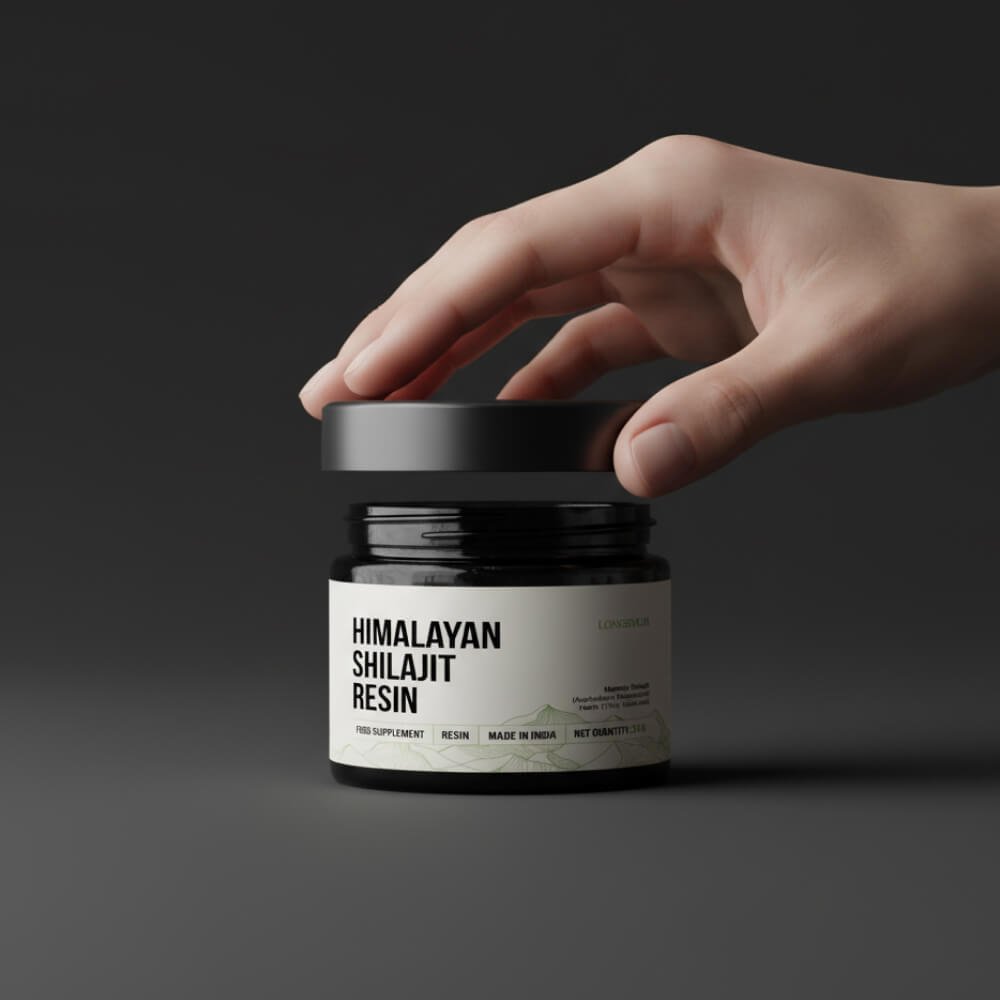
Shilajit is sold in several forms: pure resin, capsules containing dried extract or powder, tablet form, and liquid extract drops. The choice between forms matters more than it might initially seem — processing method, potency, bioavailability, and quality indicators all differ significantly between them.
For quality standards on our resin, visit our research and testing page. For the product, see our Himalayan Shilajit Resin page.
How Each Form Is Made
Pure Resin
Purified shilajit resin undergoes only aqueous extraction and filtration, then controlled concentration to produce the semi-solid resin form. This minimal processing preserves the natural matrix: fulvic acid, humic acid, dibenzo-α-pyrones, and trace minerals remain in their naturally occurring proportions and forms. The finished product is essentially concentrated, purified shilajit with nothing added.
Capsules and Powder
To create capsule or powder forms, the purified extract must be dried — either spray-dried (atomised droplets dried with hot air), freeze-dried (lyophilised under vacuum), or oven-dried at controlled temperature. This drying step is where differences emerge. Some bioactive compounds, particularly dibenzo-α-pyrones, are thermally sensitive. Spray drying at high temperatures may reduce DBP content compared to the original resin. Freeze-drying better preserves heat-sensitive compounds but is more expensive.
Capsule products also typically contain excipients: flow agents (silicon dioxide, magnesium stearate), anti-caking agents, and the capsule shell material (typically gelatin or HPMC). These reduce the proportion of actual shilajit per capsule and add compounds not present in pure resin.
Bioavailability: Does Form Matter?
The bioavailability question for shilajit forms has not been directly resolved by head-to-head comparative pharmacokinetic studies. However, reasoning from first principles and available data suggests that resin and high-quality freeze-dried extract are broadly comparable in bioavailability for most compounds, while spray-dried products at high temperatures may offer reduced DBP content.
An important consideration is fulvic acid integrity. Fulvic acid is water-soluble and generally survives drying processes well. The concern is with the more thermally labile compounds. When assessing any dried shilajit product, the fulvic acid percentage and DBP presence (ideally confirmed by HPLC) are the key potency indicators.
Quality Assessment: Resin vs. Capsules
Transparency of Potency
This is a significant advantage of resin over most capsule products. With resin, you can directly measure fulvic acid concentration and physical authenticity markers (solubility test, temperature response). With capsules, you are dependent on the label’s stated content — which, without a published fulvic acid percentage confirmed by a third-party CoA, is difficult to verify.
Many capsule products do not publish a fulvic acid percentage at all. A product stating “500 mg shilajit extract per capsule” with no potency disclosure could contain 500 mg of 15% fulvic acid material (75 mg actual fulvic acid) or 500 mg of 50% fulvic acid material (250 mg fulvic acid) — a threefold difference in potency that the label does not reveal.
Adulteration Risk
Capsule and powder forms are more susceptible to adulteration than resin because the powdered form cannot be physically tested the way resin can (solubility test, temperature response, flame test). A capsule could contain any powdered dark material without obvious detection by the consumer. This does not mean all capsule products are adulterated — but it does mean consumer verification is harder.
Practical Comparison: Convenience vs. Potency
| Factor | Pure Resin | Capsules/Powder |
|---|---|---|
| Potency | Highest — full natural matrix intact | Moderate — depends on processing method |
| Bioavailability | High | Variable — depends on excipients and processing |
| Quality verification | Easy — physical tests + CoA | More difficult — CoA essential |
| Taste | Strong earthy flavour | Tasteless (capsule) |
| Convenience | Requires dissolving | Easy — swallow with water |
| Authenticity risk | Lower — physically testable | Higher — more opacity |
| Additives | None in pure resin | Typically contains excipients |
Which Should You Choose?
For those prioritising potency, authenticity, and the most complete shilajit matrix — resin is the preferred form. It is how shilajit has been used historically, it is the most directly testable form, and it involves the least processing.
Capsules are appropriate for those who cannot manage the taste or for whom the preparation inconvenience is a genuine barrier to consistent use. If choosing capsule form, select a product that publishes a specific fulvic acid percentage confirmed by a named third-party laboratory.
Our Himalayan Shilajit Resin is available in pure resin form, with full third-party testing documentation available through our research and testing page.