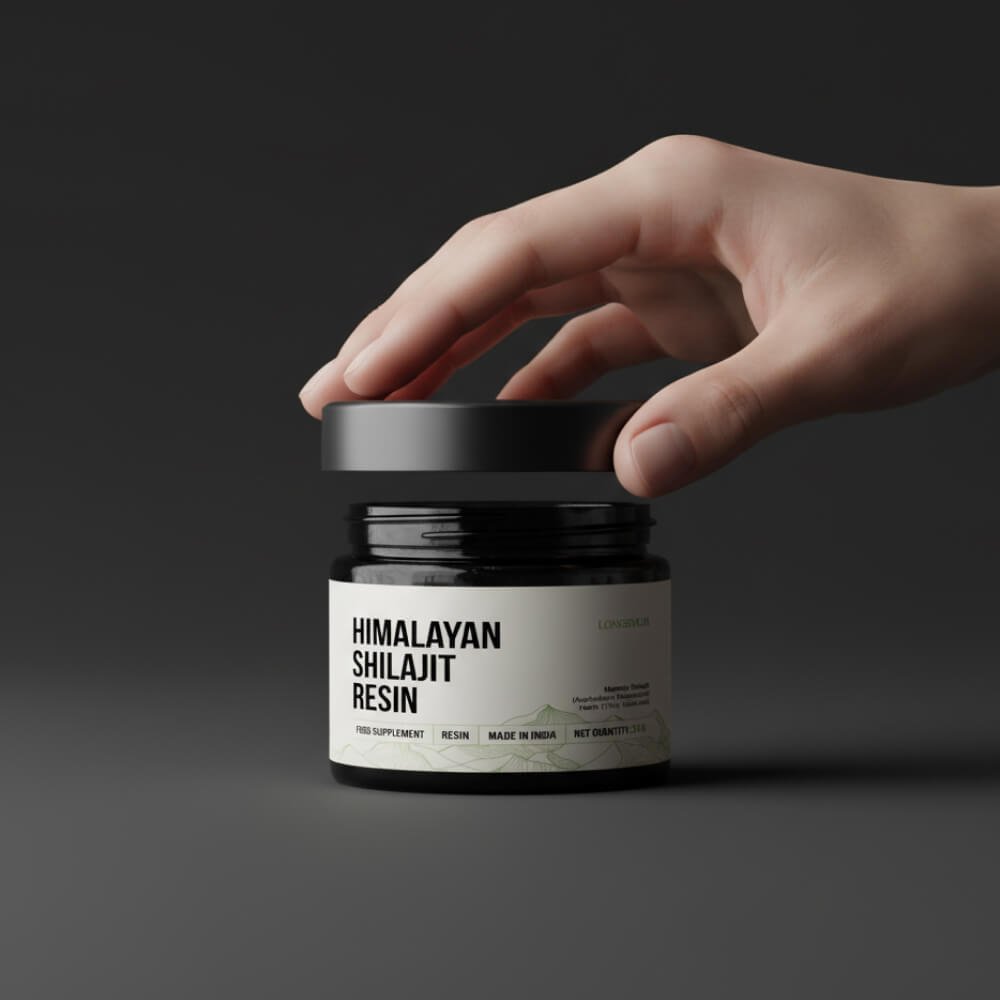
Scientific interest in shilajit has grown substantially over the past two decades, with peer-reviewed studies spanning pharmacology, clinical medicine, sports science, and neuroscience. This page provides a structured overview of the key research areas, the most important studies, and an honest assessment of where the evidence is strong versus where it remains preliminary.
For the quality and testing methodology behind our product, see our research and testing page. For the product itself, visit our Himalayan Shilajit Resin page.
1. Foundational Chemical Characterisation Research
Before clinical research could proceed meaningfully, shilajit needed rigorous chemical characterisation. The pivotal work was done by Shibnath Ghosal and colleagues at Banaras Hindu University. Ghosal’s landmark 1990 paper in Pure and Applied Chemistry established the framework defining shilajit’s major compound classes: fulvic acid, humic acid, and the unique dibenzo-α-pyrone (DBP) compounds. This paper remains the foundational reference in shilajit chemistry.
Subsequent characterisation work by multiple groups across India, Russia, and the US refined this framework, establishing methods for verifying authenticity (DBP presence) and quality (fulvic acid percentage) now standard in the industry. Schepetkin et al. (2009) in Phytotherapy Research conducted comparative analyses of shilajit samples from different Eurasian sources, confirming the significant compositional variability between geographic origins and underscoring the need for source-specific quality verification.
2. Testosterone and Male Reproductive Health Research
The most robust human clinical evidence for shilajit concerns testosterone support and male reproductive function.
Biswas et al., 2010 — Sperm Quality in Infertile Men
This randomised, placebo-controlled trial enrolled 60 infertile men with oligospermia (low sperm count). Participants received 100 mg of shilajit twice daily or placebo for 90 days. The treatment group showed statistically significant improvements in total sperm count (+61.4%), sperm motility, and normal sperm morphology (+18.9%). Serum testosterone also increased significantly in the treatment group. The study used processed shilajit at a relatively low dose, making its positive findings especially notable.
Pandit et al., 2016 — Testosterone in Healthy Ageing Males
This double-blind, randomised, placebo-controlled study enrolled 75 healthy male volunteers aged 45–55. Participants received 250 mg of processed shilajit twice daily for 90 days. Results showed statistically significant increases in total testosterone (20.45%), free testosterone (19.17%), and DHEA (31.4%) versus placebo. All safety biomarkers remained within normal ranges. This is currently the most rigorous human testosterone study in the shilajit literature and is discussed in depth on our shilajit testosterone study page.
3. Mitochondrial Energy and Physical Performance Research
Bhavsar et al., 2016 — DBPs and Mitochondrial Function
This mechanistic study demonstrated that dibenzo-α-pyrones from shilajit interact with CoQ10 in the mitochondrial electron transport chain, stimulating complex II activity and enhancing ATP synthesis efficiency. This research provided the biochemical mechanism underlying shilajit’s traditional use for fatigue — a cellular explanation for the observable energy effects reported by users across thousands of years.
Keller et al., 2019 — Muscular Strength and Recovery
A double-blind, placebo-controlled study in healthy male subjects examining 500 mg/day of purified shilajit over 8 weeks on muscle performance. The treatment group showed statistically significant improvements in maximal isometric force in leg extension and leg curl exercises versus placebo, with improved recovery from resistance exercise also noted. This is one of the most methodologically rigorous performance studies on shilajit to date.
4. Cognitive and Neuroprotective Research
Carrasco-Gallardo et al., 2012 — Tau Protein and Cognitive Relevance
This study investigated shilajit’s potential relevance to Alzheimer’s disease pathology. Fulvic acid from shilajit inhibited tau protein aggregation in cell culture models and disrupted preformed tau filaments. The paper also reviewed DBPs’ interaction with CoQ10 in neuronal energy metabolism. These are in vitro findings that establish mechanism plausibility but do not constitute clinical evidence of effect in human neurodegenerative disease.
Animal Memory Studies
Multiple rodent studies using morris water maze and passive avoidance paradigms have demonstrated improvements in spatial memory and learning following shilajit or fulvic acid supplementation. Consistent direction across independent studies provides biological plausibility for cognitive investigation, though human RCTs for cognitive endpoints remain a significant gap. The fulvic acid research page covers the cognitive research in more detail.
5. Antioxidant Research
Shilajit’s antioxidant activity has been characterised in multiple laboratory analyses using DPPH, FRAP, and ABTS assay methods. Agarwal et al. (2011) demonstrated significant free radical scavenging activity in fulvic acid fractions that correlated linearly with fulvic acid concentration. Yuan et al. (2004) found shilajit-derived fulvic acid exhibited higher antioxidant activity than leonardite-derived equivalents, reflecting structural differences from the different formation environments. A dedicated review is available on our shilajit antioxidant research page.
6. Mineral Content and Bioavailability Research
The trace mineral profile of authentic shilajit has been characterised by ICP-MS analysis across multiple studies. Ghosal’s foundational work documented over 80 trace minerals. The mineral delivery mechanism — fulvic acid chelation enhancing bioavailability — is supported by absorption studies in cell models (Glahn et al.; Gandy et al. 2018). A full breakdown is available on our minerals in shilajit page.
Honest Assessment: Gaps in the Research Base
Responsible reporting on shilajit research requires acknowledging its limitations:
- Sample sizes: Most positive human studies involve 60–75 participants — adequate for signal detection but not definitive. Large multi-centre RCTs are absent.
- Study duration: The longest published human trials run 90 days. Long-term safety and efficacy data beyond this window are lacking.
- Cognitive endpoints in humans: The cognitive research base is primarily in vitro and animal. Human RCTs for cognitive function are a significant gap.
- Female populations: Most clinical studies enrolled only men. Generalisability to women is limited by the available evidence.
- Standardisation variability: Different studies have used different preparations at varying fulvic acid concentrations, complicating direct comparison.
Conclusion
The scientific research on shilajit supports several of its traditional applications — testosterone support, physical performance, mitochondrial energy enhancement, and antioxidant activity — with meaningful human clinical evidence. The evidence base is smaller than for some other well-studied adaptogens but is growing consistently. Cognitive function and long-term systemic effects remain under-researched relative to their potential significance.
To see how we apply research standards to product quality, visit our research and testing page. To explore the product, see our Himalayan Shilajit Resin page.
Key References
- Ghosal S (1990). Chemistry of Shilajit. Pure and Applied Chemistry, 62(7), 1285–1288.
- Biswas TK et al. (2010). Spermatogenic activity. Andrologia, 42(1), 48–56.
- Pandit S et al. (2016). Testosterone supplementation with shilajit. Andrologia, 48(5), 570–575.
- Bhavsar SK et al. (2016). DBPs and mitochondrial function. Archives of Pharmacal Research.
- Keller JL et al. (2019). Muscular strength and shilajit. J Int Soc Sports Nutr.
- Carrasco-Gallardo C et al. (2012). Shilajit: Procognitive Activity. Int J Alzheimer’s Dis.
- Schepetkin IA et al. (2009). Bioactivity of Soil Humic Acids. Phytotherapy Research, 23(12), 1653–1662.
- Agarwal SP et al. (2011). Antioxidant activity of fulvic acid. J Agric Food Chem.